How does a via ferrata trip in the Jura work?
If you have never done via ferrata before, it can look far more technical than it really is. In practice, a guided trip in the Jura follows a fairly simple structure: meet the guide, get equipped, take the safety briefing, move through the route, then walk back.
What changes from one site to another is mostly the level, the length and the amount of exposure. The overall organisation stays straightforward.
Quick answer
- meet at the agreed starting point
- get fitted with equipment
- short access walk depending on the site
- safety briefing on the cable system
- move through the route section by section
- walk back and remove gear
1. Meeting point and equipment
The outing starts at the meeting point with the guide. This is when the group confirms the booking, asks last questions and adjusts the stated level if needed.
On a guided outing, the technical equipment is usually provided:
- helmet
- harness
- via ferrata lanyards
- sometimes extra gear depending on the route
On your side, you mainly need to bring:
- closed shoes with decent grip
- water
- clothing that lets you move and lift your legs easily
- a light windbreaker if conditions are variable
Gloves are not mandatory, but some people like them for comfort on the cable and metal rungs.
 The start is mostly about setting the gear correctly and getting everyone into the right level of attention.
2. Access walk and safety briefing
Depending on the site, there may be a few minutes of walking before the actual start of the route. This access section is often short, but it already helps set the group's rhythm.
Before climbing, the guide explains the basics that really matter:
- how to stay clipped correctly to the safety cable
- how to pass an anchor point
- how much distance to keep between participants
- how to use your feet before pulling with your arms
- what to do if you tense up on an exposed section
This briefing matters a lot. Via ferrata is not technically complex, but the movements need to be clean from the start.
3. Moving through the route
Once on the route, the group progresses one section at a time. The guide sets the pace, points out footholds and helps keep the movement steady.
Depending on the site, you may find:
- metal rungs on rock walls
- more exposed traverses
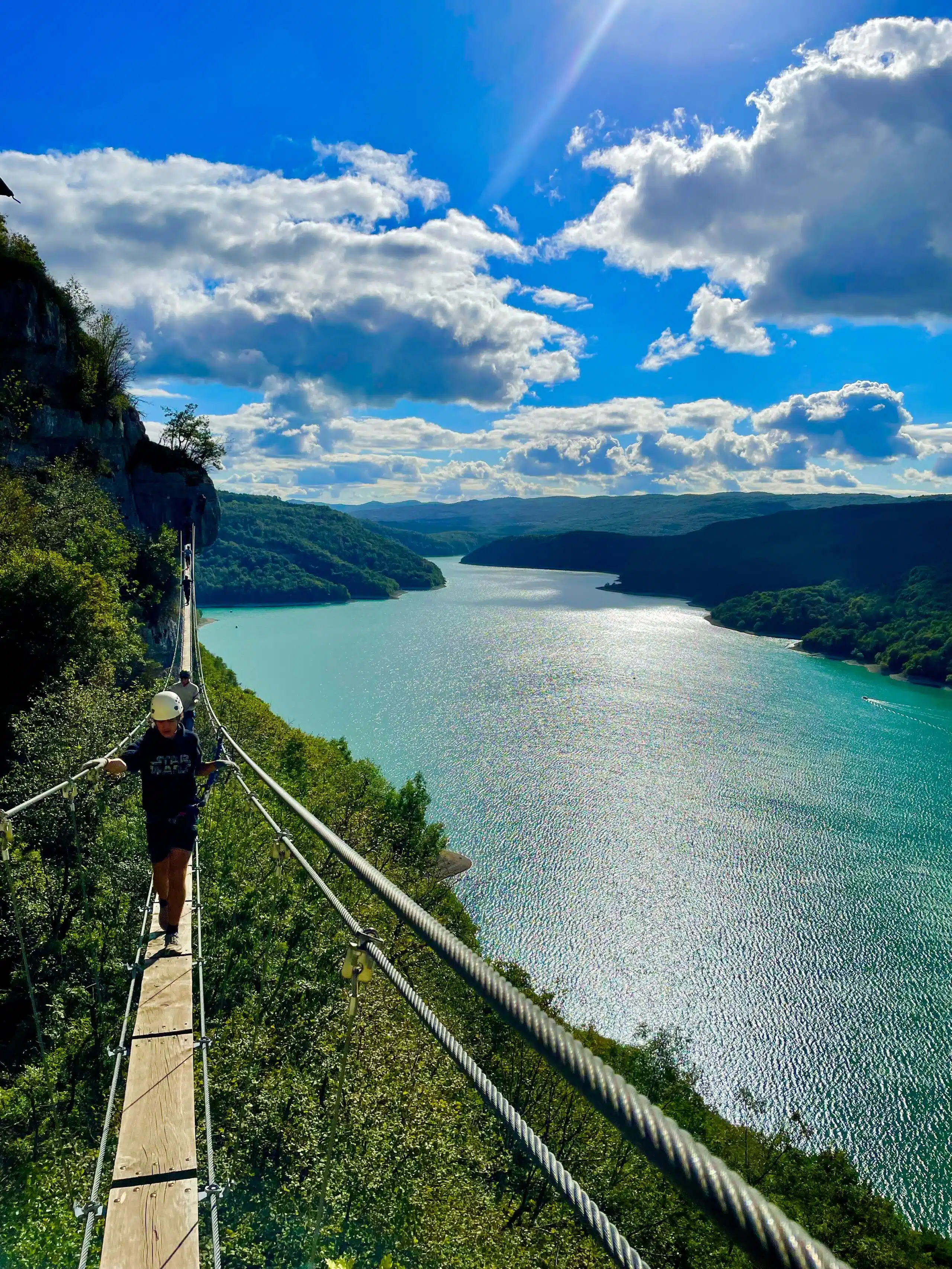
- monkey bridges
- footbridges
- zipline sections on some routes
- easier or more physical variants
Not all Jura via ferrata routes feel the same. Vouglans is often the easiest first route to read. Morez fun adds a more playful rhythm. More committed sites such as Charquemont require more endurance and more comfort with exposure.
 The guide does not only move the group forward, they also manage pace and decisions on exposed sections.
4. What if someone freezes?
That is a real question, especially on a first outing.
The best time to deal with it is before booking, not halfway through the route. If one person is uneasy with heights, say it clearly. That makes it easier to direct the group toward a suitable site such as Vouglans or Morez fun, instead of a more physical route.
Some sites have escape options. Others require you to finish once you are committed. That is why route choice matters as much as motivation on the day.
5. Return and total duration
After the last section, there is usually a walk back to the starting point or the vehicles. The group then removes the equipment and does a short debrief.
For most guided outings in the Jura, you should plan on a half day, usually around 2.5 to 4 hours in total depending on the site, the group size and the overall pace.
That timing includes:
- the welcome and check-in
- equipment fitting
- the access walk
- the briefing
- the route itself
- the walk back
6. Which route should you choose for a first time?
If your goal is simply to discover the activity, do not start with the most intimidating photo.
For a first outing, the simplest logic is often:
- Vouglans for a readable, modular route
- Morez fun for a more playful format
- avoid the sportiest routes if one person in the group is already unsure
If you want to compare sites before booking, the most useful next step is to check the via ferrata trips in the Jura.
Bottom line
A via ferrata trip in the Jura is much more structured than it may look from the outside. The guide equips the group, explains the key movements, manages the progression and adapts the pace to the announced level.
For a first outing, the most important thing is not choosing the most spectacular route. It is choosing the one the whole group can finish calmly.