Jura via ferrata after a thunderstorm: keep the outing, change site or postpone?
After a thunderstorm, a via ferrata in the Jura is not automatically cancelled, but it is not automatically safe to keep either. The right reflex is simple: make sure the storm risk is truly behind you, then let the professional judge whether the rock, the route and the group still keep enough margin.
A sunny break is not enough. In via ferrata, what matters is the real grip on the rock, the weather stability for the whole time slot, and the group's ability to keep moving cleanly on more exposed terrain.
Quick answer
- another thunderstorm still possible during the outing: it is better to postpone
- heavy storm just before the outing or earlier the same day: the trip may still be possible, but only after a clear check from the guide
- short shower followed by a genuine improvement: the outing can sometimes be kept or shifted
- first-timers, teenagers or hesitant participants: you need even more margin
- best reflex: do not decide from a brief sunny break, decide from the rock, the site and the real weather window
The real issue is not just the rain, but what the storm leaves behind
On a via ferrata, the problem is not simply whether you accept getting wet. The real issue is what the thunderstorm has changed on the ground.
The rock may stay more slippery, some footholds may feel less obvious, and the group may tense up faster if the start happens in borderline weather. Above all, a protected route on exposed terrain does not leave the same margin as an ordinary walk if the sky still feels uncertain.
That is also why a sunny car park does not tell you enough on its own. You need to know whether the site has really dried, whether wind or lingering moisture still matter, and whether another unstable cell may return during the outing.
 After a thunderstorm, the right question is not whether you can tolerate discomfort. It is whether the route is still clean to read and manage.
When can the outing still go ahead?
An outing can sometimes still make sense if several signals stay positive:
- the storm has clearly passed and no new storm risk is expected
- the rock has recovered enough grip
- the chosen route stays short and readable
- the group really fits the level of the site
- the guide clearly confirms the outing without forcing the original plan
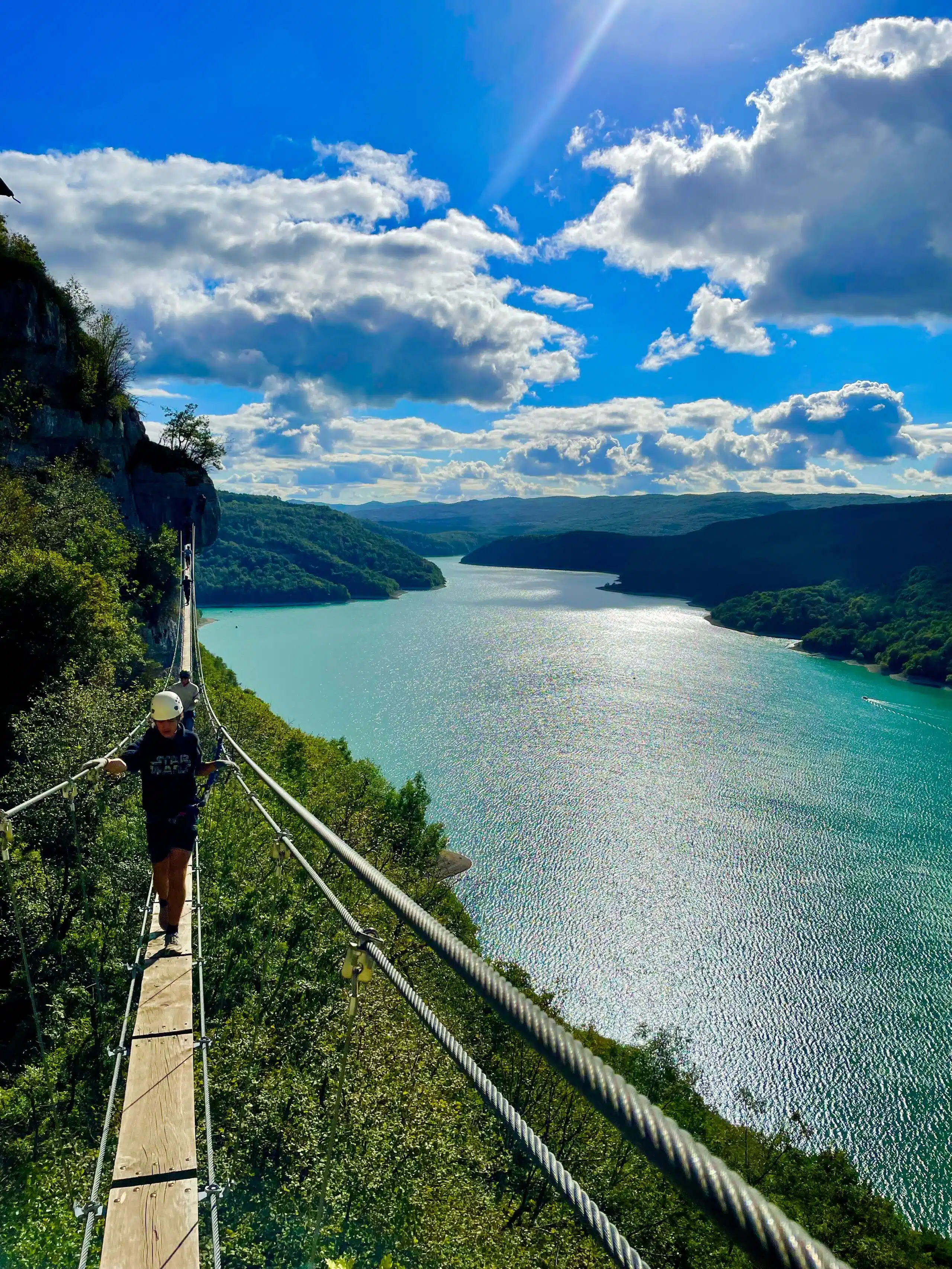
Once the weather window becomes clean again, the best move is often to stay on a simple format. A route like Vouglans usually makes more sense than an outing chosen mainly for a more impressive or sporty image.
When should you clearly move or postpone?
It is better to change site, move the time slot or postpone if:
- another storm may come back during the outing
- the rock still feels clearly wet or slippery
- the guide suggests a simpler format or another day
- the group is truly beginner-level or already lacking confidence
- you are mostly trying to save the booking at any cost
The wrong decision is not to cancel. The wrong decision is to keep a mediocre via ferrata in mediocre conditions with a group that no longer has enough margin. On an aerial route, protecting the experience matters more than sticking to the first plan.
 When conditions have shifted, the right choice is not the most spectacular route. It is the one the group can finish cleanly and calmly.
What kind of route makes sense after borderline weather?
If the outing is maintained once the weather is stable again, do not chase the most aerial via ferrata. Choose the route that is easiest to read for that specific group.
- a short format is often more relevant than a packed half-day
- a clear route is better than a site the group discovers while already feeling tense
- if someone is unsure about height, this is not the right day to test their maximum margin
This is not a rigid rule. It is exactly the kind of decision that should stay with the professional based on rock conditions, wind, humidity and the group's real comfort level.
What should you ask before leaving?
If the weather has turned, four questions are often enough:
- Is the outing definitely going ahead today?
- Are you keeping the same site, or switching to an easier format?
- Is the morning or afternoon slot better after the storm?
- Should we keep a real backup plan if the sky stays unstable?
Those questions usually give a much more useful answer than checking the forecast app one more time.
Should you keep a backup plan?
Yes, especially in summer when storm cells can come back quickly. The right backup is not always another vertical activity. An exposed hike, a wet cliff or a canyon reacting to rainfall can all lose their value too.
The simplest option is often to keep a flexible slot, a short visit or a lighter plan if conditions do not really clean up.
Useful links
- Jura via ferrata when it rains: should you cancel or just change the plan?
- Which Jura via ferrata should you choose for your level?
- Guided via ferrata in the Jura
Bottom line
After a thunderstorm, a via ferrata in the Jura can sometimes still go ahead, but only if the storm risk is really over, the rock becomes reliable again, and the chosen route fits the group. The best reflex is not to save the outing at any cost. It is to accept an easier site, a different time slot or a postponement if the safety margin is no longer good enough.